

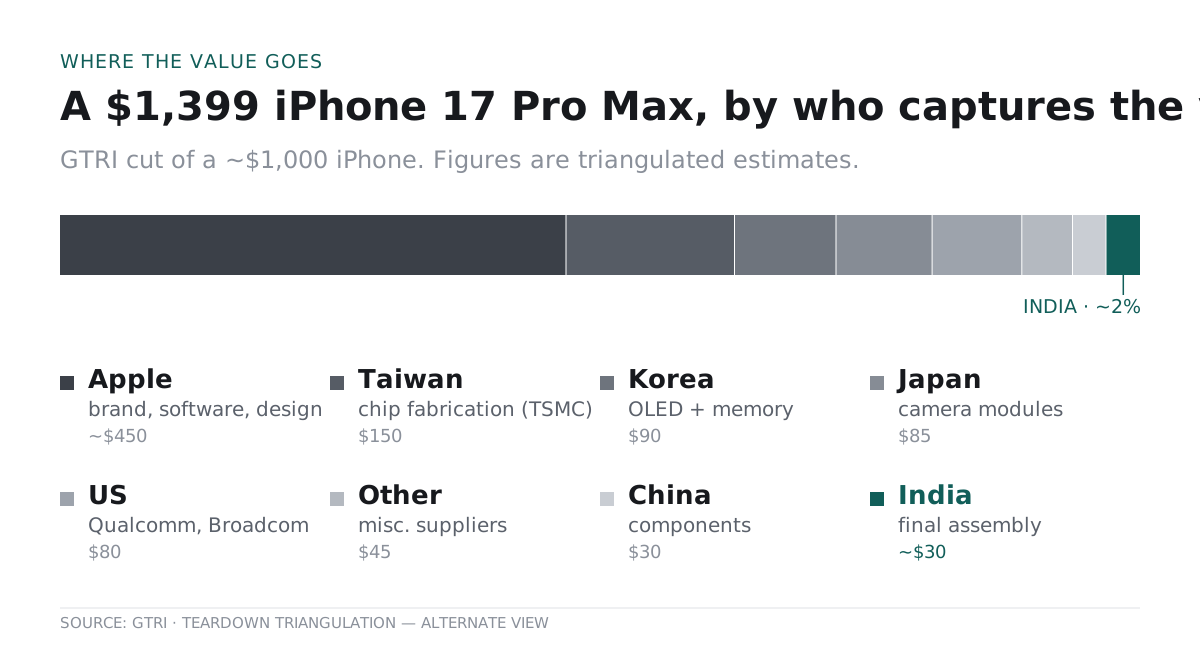
India makes 1 out of 4 iPhones sold in the world, but, it only makes ~2% of money made out of each.
A decade ago that would have sounded implausible. Today, it is an industrial fact for which India deserves its credit.
Yet, opening opening a 17 Pro Max model reveals a different geography of value.
India’s contribution remains concentrated in the final assembly and selected mechanical components, which together are ~$25–30 on a $1,399 device sold in retail.
The statistic can be read in two different ways.
A pessimistic view can be that India barely captures anything out of the retail value from one of the world’s most profitable consumer products.
The more useful reading is that India solved the hardest problem first: proving it can manufacture premium electronics reliably, and that at global scale. The next challenge is not the assembly, but building the valuable things that goes inside them.
India’s Electronic Story
In April 2020, the Ministry of Electronics and Information Technology (MeitY) notified the first Production Linked Incentive (PLI) scheme for Large Scale Electronics Manufacturing (LSEM) focusing on mobile phones and critical components with a 3% to 6% incentive, to give a boost to domestic manufacturing under the vision of Atma Nirbhar Bharat, and to make India a global manufacturing hub.
The ambition was larger than import substitution. It was to insert India into one of the world’s most sophisticated manufacturing supply chains.
Apple’s contract suppliers arrived in stages. Wistron had already begun assembling entry-level iPhones in Bengaluru by 2017. Foxconn expanded into premium models from its Tamil Nadu facilities, while Pegatron entered in 2020 to diversify Apple’s manufacturing footprint.
What began as three Taiwanese contract manufacturers has since evolved into something more distinctly Indian, with Tata Electronics acquiring Wistron’s operations in 2023 and taking control of Pegatron India, becoming Apple’s first major Indian manufacturing partner.
The results exceeded even the scheme’s own ambitions. Over the five-year smartphone PLI, Apple and its partners produced roughly US$70 billion worth of iPhones against an initial commitment of about US$39 billion, while India grew from assembling niche domestic models to producing roughly a quarter of the world’s iPhones.
None of that should be waved away. Assembling a flagship phone at global quality, at the scale of tens of millions of units a year, is not a small achievement – it is the hard, unglamorous foundation that every climb up a value chain is built on.
India laid it in under a decade: some 55 million units in 2025, a quarter of global output, exports past ₹2 lakh crore, and roughly 250,000 jobs. Those numbers deserve appreciation.
Yet success in manufacturing scale is not the same as success in value capture. That distinction is where the real story begins.
Mapping The Chain – BOM
A teardown of the latest flagship model iPhone 17 Pro Max (512 GB) suggests a Bill of Materials (the BOM) of roughly ~$615. Against a $1,399 retail price, with a retail-over-BOM markup of ~56%, most of the economic value is clearly created somewhere other than manufacturing.
The distribution of component cost and where it’s captured tells the story:
| Component | Est. cost | % BOM | Value Captured |
|---|---|---|---|
| Camera subsystem | ~$169 | 27.5% | Sony (Japan), LG Innotek (Korea) |
| Display – LTPO OLED | ~$115 | 18.5% | Samsung / LG Display (Korea), India: zero OLED fab |
| Processor – A19 Pro | ~$92 | 15% | Apple (US design), TSMC (Taiwan fab) |
| Memory & Storage | ~$70 | 11.5% | Samsung / SK Hynix / Kioxia – up on memory shortage. |
| Connectivity & RF | ~$55 | 9% | Qualcomm, Broadcom (US / Taiwan) |
| Casing, mechanics, thermal | ~$45 | 7.5% | India’s beachhead – Tata / Foxconn machining |
| Sensors – Face IDST | ~$15 | 2.5% | STMicroelectronics (Europe) |
| Battery & power | ~$15 | 2.5% | China ; Localised pack assembly in India |
| Final assembly – FATP | ~$25 | 4% | Foxconn, Pegatron, Tata 2–4% net margins |
The pattern is striking – the top four value-drivers camera, chip, display, memory are about ~72% of the total physical cost. Each belongs to an ecosystem which is built over decades: Sony’s imaging sensors, Samsung’s OLED displays, TSMC’s semiconductor fabrication, and the memory giants of Korea and Japan.
But one thing which stands out is that India fabricates none of them (yet). Instead, its foothold lies in precision machining, enclosure manufacturing and final assembly. Those activities are indispensable, but they are not where the industry earns its highest returns.
Follow The Money
The economics of business becomes much clearer when working capital enters the picture.
Apple’s business is remarkable not simply because it earns exceptional margins for its brand and design, but because its own supply chain finances much its operations.
Its cash conversion cycle remains deeply negative. Customers typically pay Apple weeks before Apple settles many supplier invoices. Apple runs one of the most aggressive working-capital profiles in corporate history
Apple’s cash-to cash cycle nears around −72 day, which means it is paid for the iPhone roughly two and a half months before it pays the people who built it.
Contract manufacturers live in the opposite world. Value in this supply chain is structurally captured upstream and withheld from assembly.
The assemblers absorbs the mirror image: a positive +38 day float – it funds itself, just to earn barely 2–4% on the ~$25–30 of assembly value. In other words, the Indian assembler finances roughly 38 days of inventory to earn about $1 on a $1,399 phone.
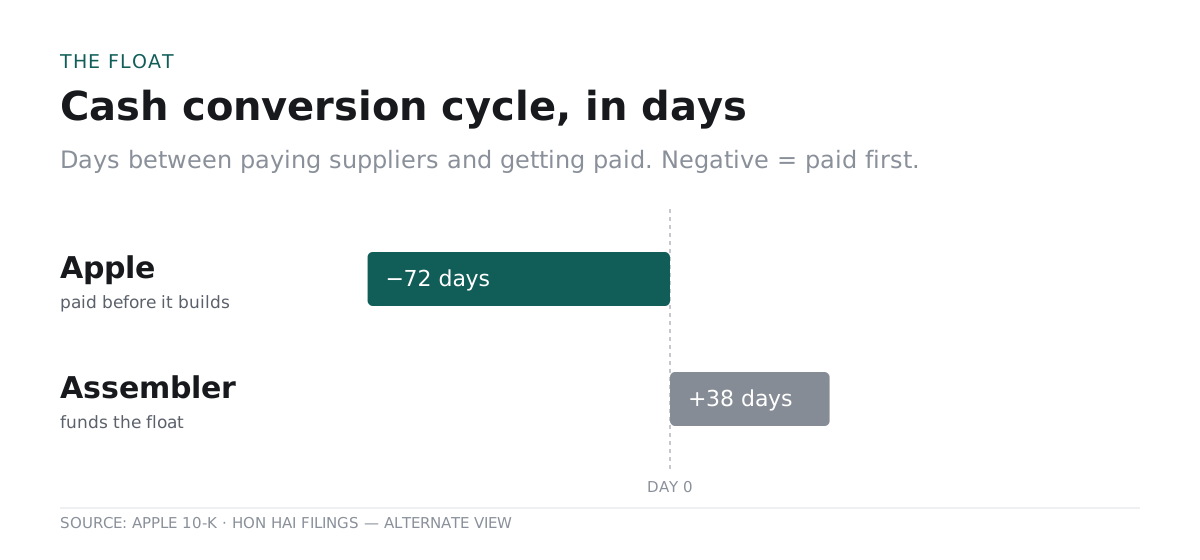
The contract assembler is not merely performing lower-value work – it is committing significant capital to earn comparatively little. The float requirement is itself the barrier to entry.
The assembly resembles infrastructure more than software. It rewards operational excellence, scale and inexpensive financing but not the intellectual property where the actual money lives.
This is mainly why the business naturally concentrates among handful of firms – Foxconn, Tata Electronics and Pegatron.
India’s DVA Debate
By early FY26, Government agencies such as MeitY and ndia Cellular & Electronics Association (ICEA) declared Apple’s contract manufacturers had crossed 20% domestic value addition (DVA) for phones exported from India.
GTRI – an independent research firm – and economists however argue that the true value added on Indian soil sits nearer the low single digits for pure assembly.
The gap is an accounting artefact. Under a “gross-sourcing” convention, the domestic assembly of an imported sub-component gets credited as Indian value. One of the GTRI’s damning claim is that the subsidy paid on a phone has in some cases exceeded the value the manufacturer actually added in India.
Well, neither calculation is mathematically incorrect. They simply answer different questions.
One – how much production takes place in India, The other measures how much economic value remains there.
The distinction matters because industrial policy aims to increase the second, not merely the first.
Climbing The Value Chain
The strongest evidence that policymakers recognised the limits of an assembly-led strategy is the expansion of the Electronics Component Manufacturing Scheme (ECMS). Launched with an outlay of ₹23,000 crore and later raised to ₹40,000 crore in the February 2026 Budget, the scheme marks an explicit shift from rewarding assembly to nurturing domestic component manufacturing – part of the value chain where the greatest economic value is created and retained.
The market is already responding. The ECMS scheme has drawn roughly ₹1.15 lakh crore in investment commitments – close to double its original target -spanning printed circuit boards, camera and display modules, connectors, passives and battery materials, and including India’s first rare-earth permanent-magnet unit. That last one matters: it is the clearest sign the climb has moved from policy intent to funded fact.
Interestingly, this shift is explicit in the government’s own narrative. While launching the ECMS, the government described India’s electronics strategy as a progression – first finished products to build scale, then modules, then components, and finally materials. Policymakers themselves are now framing assembly as the starting point of industrial deepening, not its endpoint.
The ECMS targets precisely the components that turn an assembly base into a manufacturing ecosystem: connectors, camera modules, printed circuit boards (PCBs), passive components, battery materials, and precision mechanics.
Now, these are unlikely to generate headlines like semiconductor fabs, but collectively they represent a much larger opportunity for domestic value capture.
When a government stops paying for assembly and starts paying for components, it is telling you the assembly-value story had run out of runway.
Verdict – A Triumph Of Scale, Value Capture Next.
History suggests India’s trajectory is neither unique nor unusual.
Japan built consumer electronics before mastering components. South Korea climbed from contract manufacturing to memory chips and displays. Taiwan became indispensable through semiconductor fabrication. China spent two decades moving from assembly into batteries, camera modules, precision mechanics and increasingly advanced chip packaging.
Assembly is the common starting point – never the destination.
India has already demonstrated that it can manufacture at global scale and integrate into one of the world’s most sophisticated supply chains. That achievement deserves recognition. The challenge now is to translate manufacturing scale into manufacturing value.
But the real question is this: Is this merely the peak of India’s manufacturing story, or the beginning of a much larger industrial transition?
Today, India assembles one of the world’s most sophisticated consumer products while capturing only a modest share of value.
The opportunity is not to build more iPhones, but to build more of each iPhone.
India’s electronics journey has unfolded in layers. The first chapter was finished-product assembly under the smartphone PLI. The next chapter is modules and components under ECMS. Whether India eventually reaches the final layer – advanced materials and leading-edge fabrication – will determine how much of the electronics value chain it ultimately owns.
India has proven it can build the box brilliantly. Whether it can make the brains is the question the next five years, not the last five, will answer..
Method Note and Sources
This teardown followed Alternate View’s standing discipline: triangulate every “India value” number against an independent one; keep “assembled in India” and “value added in India” in separate columns; and label metrics precisely (markup ≠ gross margin).
Sources : Apple SEC 10-K filings; Hon Hai consolidated financials; Press Bureau of India, MeitY / ICEA statements; GTRI iPhone value-chain analysis; , ECMS documents and Union Budget 2026 releases; Counterpoint, TechInsights and Yole Group teardown estimates; Bloomberg and Business Today.
Leave a Reply