
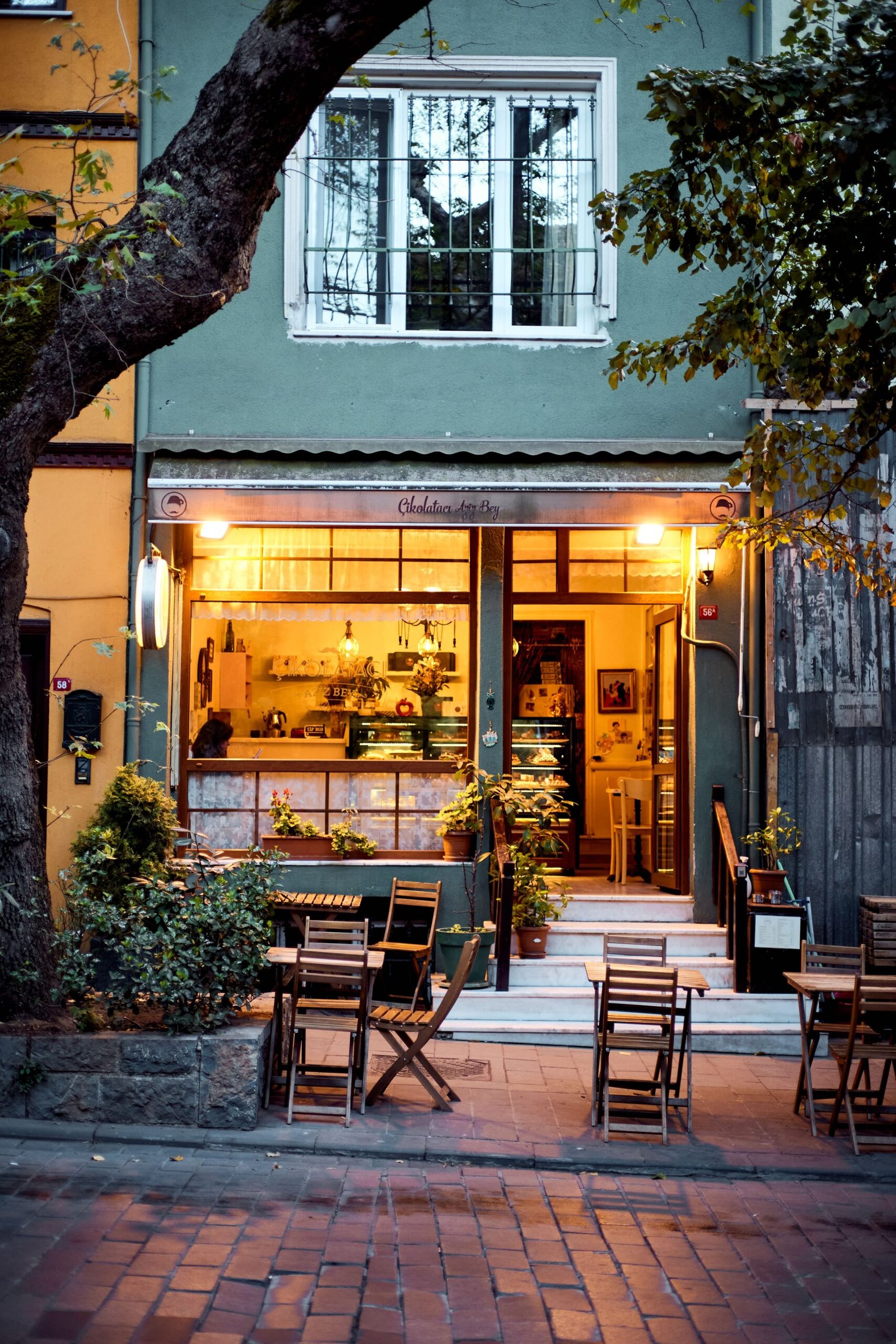
“The customer walks into a restaurant for a meal. The owner walks into a business that never stops moving.“
1. Opening a Restaurant Is One of India’s Favourite Business Dreams
Walk through any busy street in India today and one thing becomes immediately apparent – food is everywhere.
From roadside tea stalls serving hundreds of cups before sunrise to neighborhood cafés buzzing with young professionals, from cloud kitchens filling thousands of online orders to fine-dining restaurants hosting weekend celebrations, the restaurant industry has become one of the most visible faces of India’s growing consumer economy.
Rising disposable incomes, rapid urbanization, changing lifestyles and the explosive growth of food delivery aggregator platforms have fundamentally changed how Indians consume food.
Eating out is no longer reserved for special occasions. It has become part of everyday life. Whether it is a working professional ordering lunch at the office, a family celebrating a birthday, or a student meeting friends over coffee or beer, restaurants now serve experiences that extend well beyond the meal itself.
It is therefore no surprise that opening a restaurant remains one of the most popular entrepreneurial aspirations in the country.
Unlike industries such as automobile manufacturing, pharmaceuticals or electronics, the restaurant business appears accessible. The product is familiar, demand is easy to observe, and almost everyone believes they understand the customer because everyone has been a customer at some point. For many aspiring entrepreneurs, it seems like a business where passion and perseverance can naturally translate into commercial success.
The motivations are equally diverse. Some dream of transforming a treasured family recipe into a thriving business. Others hope to introduce authentic regional cuisine to a wider audience. Many professionals see restaurants as an opportunity to leave corporate careers behind and build something of their own, while investors view the sector as a way to participate in India’s consumption-led growth story.
On the surface, it is an attractive proposition. After all, people will always need to eat.
The numbers tell the same story. India’s food services industry is estimated at over US$80 billion and continues to grow at around 10% annually. The number of organized restaurants has also grown significantly over the past few years, reflecting the country’s increasing appetite for eating out.
Yet beneath this seemingly straightforward business lies one of the most operationally demanding industries in the world.
Industry estimates suggest that a majority of restaurants never make it beyond their first few years, with many shutting down within the first year itself.
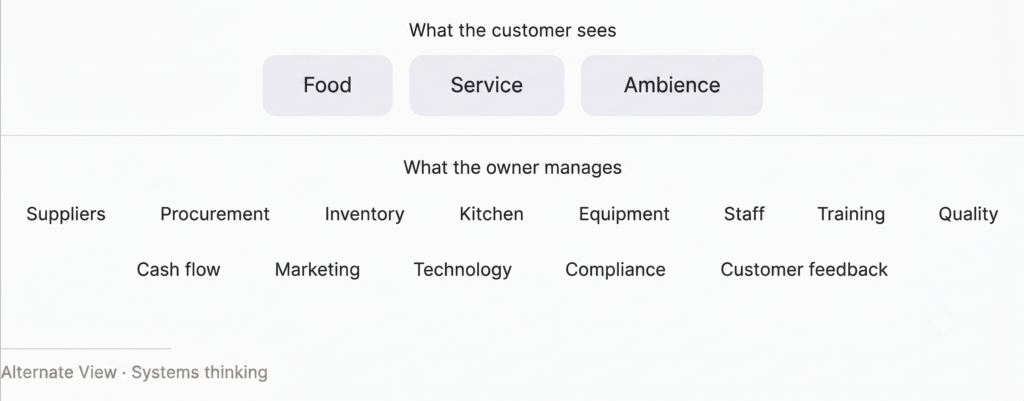
Every day, a restaurant must purchase the right ingredients, manage inventory that perishes by the hour, coordinate suppliers, train staff, maintain quality, control costs, satisfy customers and generate enough cash to do it all again the next morning. The customer experiences only a few minutes at the dining table, but the business behind those few minutes operates continuously.
That difference between what customers see and what owners manage is where the real restaurant business begins.
And before discussing menus, locations or marketing strategies, one should ask the fundamental question.
Is opening a restaurant really the right business for me?
2. Why Restaurants Fail Before They Ever Get a Chance
One of the most persistent myths in the food industry is that restaurants fail because they serve bad food.
It is an understandable assumption. Customers experience the food, so it feels natural to believe that the quality of the meal determines the success of the business. While poor food can certainly drive customers away, it is surprisingly rare for a restaurant to fail only because of what comes out of the kitchen.
In reality, restaurants often begin accumulating problems long before they serve their first customer.
A lease is signed without understanding whether the rent can be supported by the expected footfall. The menu is designed around personal preferences rather than customer demand. Kitchen equipment is purchased before the workflow is planned. Working capital is underestimated because the initial investment receives all the attention. Suppliers are chosen on price alone, without considering reliability or consistency. Hiring begins without standard operating procedures, assuming that experience alone will create consistency.
Individually, none of these decisions seems catastrophic.
Collectively, they determine whether the restaurant enters its first year with a stable foundation or a series of operational weaknesses waiting to surface.
One of the defining characteristics of the restaurant industry is that mistakes rarely announce themselves immediately. Poor inventory management may take months to appear as rising food costs. Inconsistent procurement might initially look like an occasional quality issue before gradually eroding customer trust. Excessive staffing may not seem problematic during the launch phase but can quickly become unsustainable once the excitement of opening gives way to the realities of everyday business.
By the time declining profits become visible, the underlying causes often lie in decisions that were made months earlier.
This is why successful restaurant owners spend far more time designing systems than perfecting recipes.
Because restaurants rarely fail in the dining room.
More often, they fail in the decisions that customers never get to see.
3. The Business Hidden Behind the Dining Table
Walk into any successful restaurant during peak dinner hours and the scene appears almost effortless.
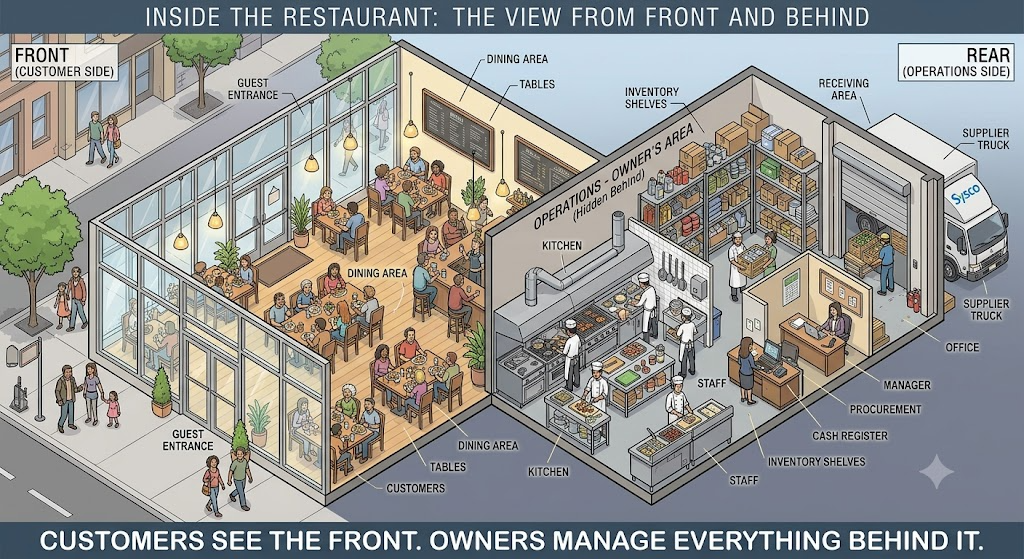
Customers browse the menu, conversations fill the room, servers move confidently between tables, and dishes arrive looking exactly as they should. From the customer’s perspective, the experience begins when they are seated and ends when the bill is paid. Everything that matters appears to happen within those forty-five minutes.
But the business began long before the first customer walked through the door.
Several hours earlier, deliveries had already arrived at the back entrance. Vegetables were inspected for freshness. Meat and dairy products were checked against purchase orders before being moved into cold storage. Inventory from the previous day was counted, ingredients were prepared for service, equipment was tested, and the kitchen was organized for the evening rush. Staff briefings were completed, reservations reviewed, and suppliers contacted for items that would be needed tomorrow.
None of this is visible to the customer. Yet every one of these activities determines whether the restaurant can deliver the experience the customer expects.
This is where many first-time entrepreneurs make their biggest mistake. They see a restaurant as a place that serves food because that is all they experience as customers. Owners, however, quickly discover that food is only the visible output of a much larger business system.
In reality, a restaurant is an organization that transforms hundreds of raw inputs into one consistent customer experience.
Those inputs are not limited to ingredients. They include supplier relationships, procurement schedules, inventory management, kitchen workflows, equipment maintenance, staffing, training, hygiene standards, pricing, cash flow and customer service.
Each function depends on the others. When one part of the system fails, the impact eventually reaches the dining table.
Consider something as simple as a tomato.
To a customer, it is just one ingredient in a sandwich or curry. To a restaurant owner, it represents a chain of business decisions.
Which supplier provides consistent quality?
How often should orders be placed? How much inventory should be held without increasing spoilage? What happens when seasonal prices double? Is there an approved alternate supplier? How does a change in quality affect the final dish? At what point does rising procurement cost require a menu price revision?
The tomato itself has not changed. The complexity behind sourcing it has.
Now multiply that thinking across every ingredient, every employee, every customer order and every day of the year. The restaurant begins to look less like a kitchen and more like a carefully coordinated operation.
This is why experienced operators rarely describe themselves as being in the food business.
Restaurant owners are in the business of delivering consistency, more than quality.
A customer who enjoys a signature dish on Monday expects exactly the same taste when returning three weeks later. That consistency cannot depend on one talented chef having a good day. It must come from standard recipes, disciplined procurement, trained staff, reliable equipment and processes that produce the same outcome regardless of who is working that shift.
Consistency is not created at the stove. It is designed into the business.
That is precisely what makes restaurants one of the most operationally demanding businesses to manage.
This perspective also explains why restaurants cannot be built by focusing on the dining area alone. Attractive interiors, creative menus and talented chefs certainly matter, but they represent only the visible portion of the business. The real competitive advantage lies in the systems that customers never see – the procurement processes that ensure ingredients arrive on time, the inventory controls that reduce waste, the kitchen layouts that improve efficiency, the training that ensures consistency, and the financial discipline that keeps the business profitable.
Customers remember the meal.
Owners remember the thousand decisions that made the meal possible.
That distinction is the foundation upon which every successful restaurant is built.
4. Are You Building a Business or Buying Yourself a Job?
One of the biggest misconceptions about entrepreneurship is that owning a business automatically gives you freedom.
In reality, many businesses simply replace one full-time job with another -except this time, the employee and the employer are the same person.
Restaurants are particularly susceptible to this trap.
Many first-time owners imagine themselves making strategic decisions while a capable team manages the day-to-day operations. The reality is often very different. During the early months, the owner becomes the purchaser, recruiter, operations manager, customer service representative, accountant and, on difficult days, even part of the kitchen staff.
This isn’t a sign of poor planning. It is the nature of a business where dozens of small decisions must be made every single day.
The real question, therefore, is not whether you enjoy food.It is whether you enjoy building and managing systems.
Can you recruit and retain people in an industry known for high staff turnover?
Can you maintain quality on a day when chefs calls in sick?
Can you negotiate with suppliers when ingredient prices rises suddenly?
Can you make difficult decisions when cash flow is tight but salaries, rent and vendor payments are still due?
These situations are not exceptional events. They are part of normal restaurant operations.
Successful restaurant owners often discover that their greatest strengths have little to do with cooking. They excel because they solve problems, make decisions with incomplete information and improve systems every single day.
This doesn’t mean you need years of restaurant experience before opening one.
Many successful operators entered the industry from completely different professions.
What they brought with them was discipline, financial prudence, the ability to manage people and a willingness to learn an unfamiliar business from the ground up.
Passion may inspire someone to open a restaurant. But systems, resilience and execution determine whether it survives.
If those challenges excite you rather than discourage you, you may be looking at the right business.
If they don’t, that doesn’t mean entrepreneurship isn’t for you. It simply means a restaurant may not be the business you should choose.
5. Not Every Restaurant Is the Same Business
Now, If you’ve decided that the restaurant business is the right fit, the next assumption to challenge is equally important.
Not every restaurant is the same business.
At first glance, this may seem obvious. A café feels different from a fine-dining restaurant, and a cloud kitchen clearly operates differently from a neighborhood bakery. Yet many first-time entrepreneurs underestimate just how fundamentally different these businesses are.
They may all prepare and sell food, but almost everything else – from investment requirements and staffing to inventory management, customer acquisition and profitability – can vary dramatically.
A cloud kitchen, for example, is designed around delivery. It doesn’t require expensive interiors or premium high-street real estate, but it depends heavily on digital visibility, efficient packaging and partnerships with food delivery platforms.
A neighborhood café, on the other hand, is often built around repeat customers and longer visits. Here, ambience, location and customer experience become as important as the menu itself. Revenue may come as much from creating a place where people choose to spend time as from the food being served.
Quick Service Restaurants (QSRs) optimize for speed and standardization. Their success depends on high customer throughput, simplified operations and the ability to deliver a consistent product within minutes.
Casual dining restaurants focus on family and group experiences, balancing food quality with service and ambience, while fine-dining establishments operate in an entirely different segment where exclusivity, presentation and personalized service justify significantly higher prices and operating costs.
Even bakeries and dessert outlets, often perceived as simpler businesses, follow different economics. Production schedules begin long before customers arrive, demand fluctuates throughout the day, and freshness directly influences both quality and wastage.
Although these businesses appear similar from the outside, they solve different customer problems.
That distinction matters because every decision that follows – location, kitchen design, staffing, supplier selection, inventory planning and marketing – depends on the business model you choose.
There is no universally superior restaurant format.
A cloud kitchen is not an upgrade over a café. A fine-dining restaurant is not inherently better than a quick-service outlet.
Each succeeds only when its operating model aligns with its target customers, available capital and the entrepreneur’s own capabilities.
One of the biggest mistakes first-time owners make is trying to combine multiple business models into one.
A premium dining experience with quick-service pricing.
A café designed for long customer visits but located in an area dominated by delivery orders.
An extensive menu that attempts to satisfy every possible customer but ultimately complicates operations and increases food waste.
Restaurants become stronger when they make deliberate choices about what they are – and equally importantly, what they are not.
Choosing the right business model is not about following trends.
It is about building a business that your systems, your finances and your customers can sustainably support.
The good news is that you don’t need to make that decision today.
The next chapter begins exactly there.
Because before deciding what kind of restaurant to build, you must first understand where it should exist.
Key Takeaways
✓ Restaurants rarely fail because of food alone; they fail because weak business systems eventually surface.
✓ Owning a restaurant means building and managing an operational system consistently – not simply serving meals.
✓ Before planning the menu, decide what kind of restaurant business you want to build and whether it suits you as an entrepreneur.
Coming Next
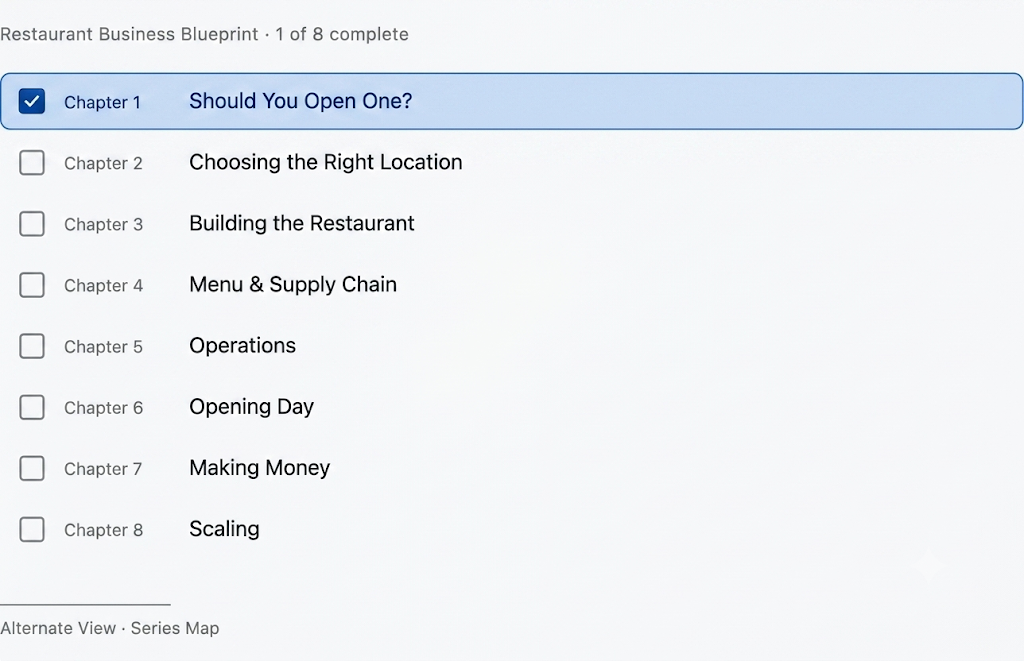
Chapter 2: Choosing the Right Location
Before a customer experiences your restaurant, they must first be able to find it. In the next chapter, we’ll explore how catchment areas, demographics, rental economics and customer behaviour influence one of the most expensive decisions every restaurant owner makes.
Leave a Reply