
1. From Contract Manufacturing to Research and Development Manufacturing
In the previous part of this series, we went in detail about contract manufacturing through the lens of the supply chain.
The basic idea was straightforward: a company does not always need to manufacture everything it sells. It can choose to outsource part of the production process to a specialist that already has the factories, people, equipment and expertise required to make the product.
Pharmaceutical Industry take that idea several steps further.
Because in pharmaceuticals, the difficult part is often not simply manufacturing the product. The difficult part is figuring out how to manufacture it in the first place.
A molecule that looks promising in a laboratory may behave very differently when the objective changes from producing small test samples for an experiment to producing tons of medicine packages consistently, safely and economically.
The chemistry may need to be redesigned and the processes need to be scaled. New advanced analytical methods needed to be developed and precise conditions during production should to be validated. Finally the regulatory requirements must be met at all cost.
And if the drug does succeeds in clinical development, the same process should eventually have to support commercial production for years.
This is where the pharmaceutical outsourcing industry begins to move beyond the traditional Contract Manufacturing Organization or CMO.
It moves towards the CDMO and, increasingly, the CRDMO.
CMO → CDMO → CRDMO
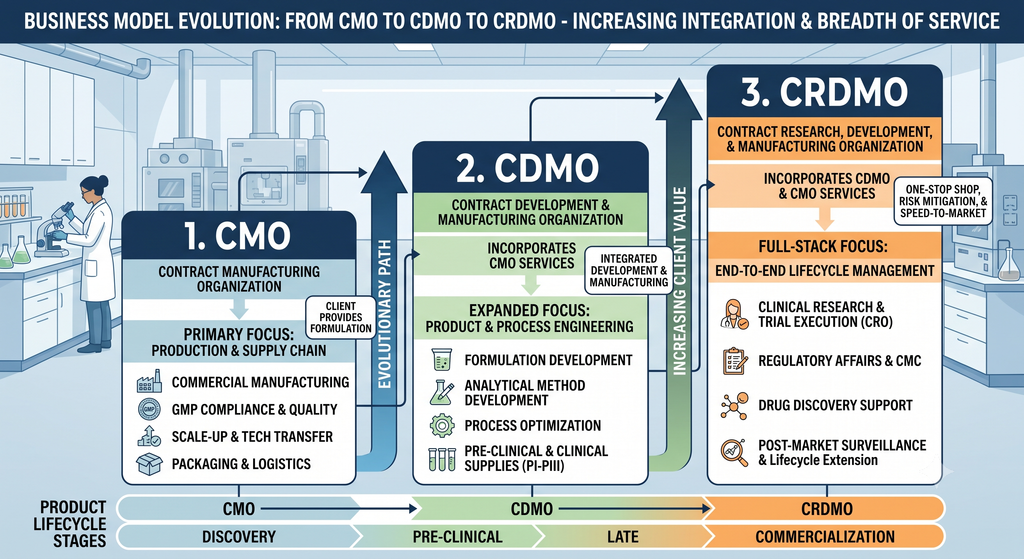
A CMO, or Contract Manufacturing Organization, primarily provides manufacturing capacity. The customer has a product design and needs someone to produce it.
A CDMO, or Contract Development and Manufacturing Organization, goes one step earlier in the value chain. The customer have discovered have a molecule, but the manufacturing process at scale still needs to be developed, optimized and scaled. The CDMO therefore combines two capabilities: Development + Manufacturing
The final stage is the CRDMO – Contract Research, Development and Manufacturing Organization.
Here, the relationship begins very early in the life cycle of a drug. The contractual partners now participates in research and development activities, process chemistry, analytical development and other technical work before eventually moving into production stage.
The boundaries between these categories are not always precise. Companies use the terms somewhat differently, and many organizations offer overlapping services. But the direction of travel is clear: outsourcing is moving from simply buying manufacturing capacity towards outsourcing a broader set of technical capabilities.
A joint research fromBoston Consulting Group (BCG) and the Innovative Pharmaceutical Services Organization (IPSO) titled “Unleashing the Tiger: Indian CRDMO Sector 2025” on India’s CRDMO sector describes the industry as spanning research, development and manufacturing and identifies this deeper integration as an important part of India’s opportunity in the global pharmaceutical supply chain.
That distinction is important.
Because a company that merely rents out manufacturing capacity is participating in one part of the supply chain.
A company that helps a pharmaceutical customer develop the manufacturing process for a molecule can become part of the knowledge chain as well.
And that changes the economics of the relationship.
2. The Molecule Is Only The Beginning
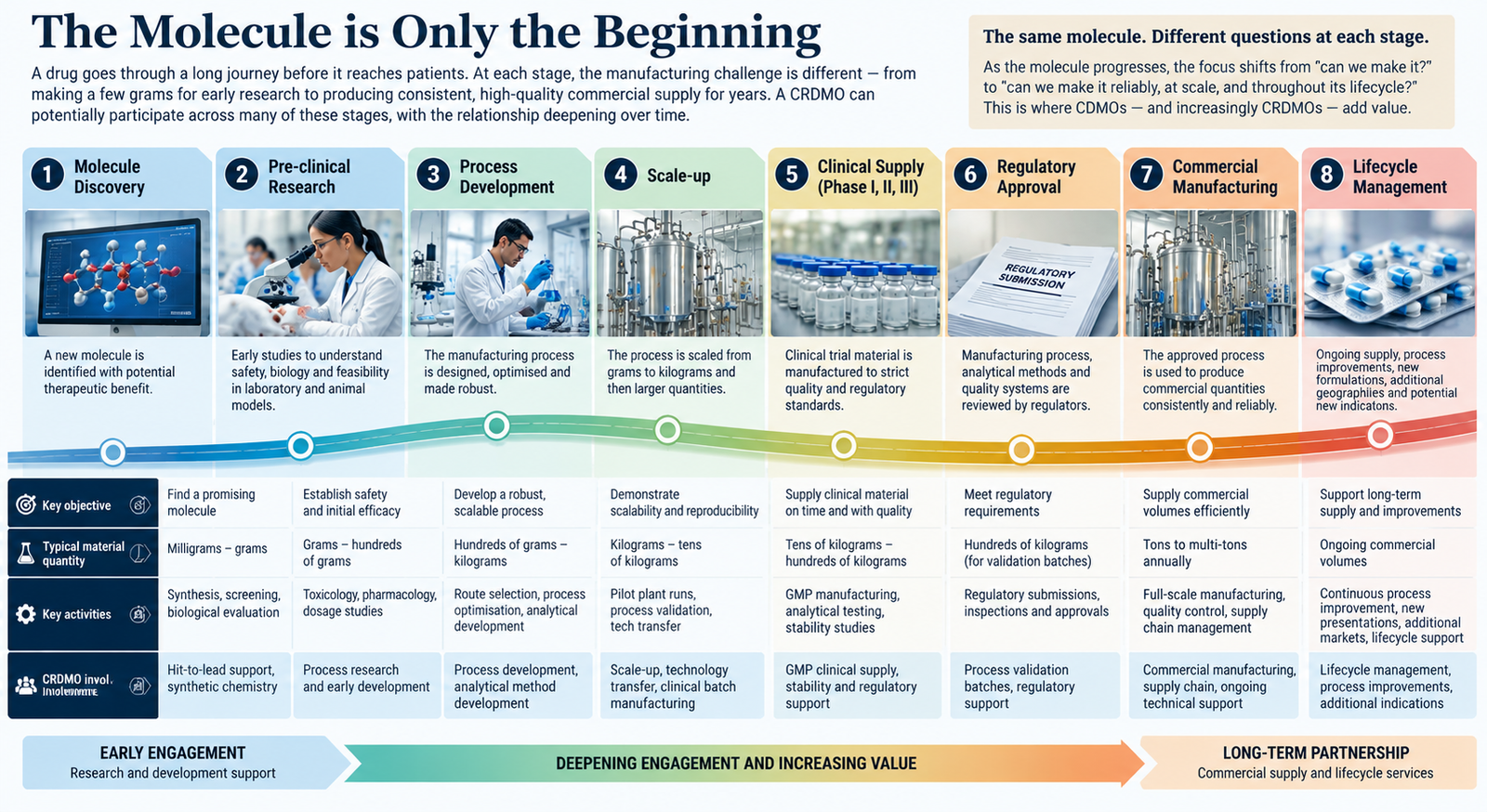
Consider this: a pharmaceutical company discovers a new molecule that appears to have therapeutic potential.
At this stage, there is very small amount of product. Perhaps grams, or even smaller sometimes.
But eventually the company will need:
- Material for pre-clinical studies and clinical trials
- Scalable and reproducible process development
- Process validation and regulatory compliance
- Commercial-scale manufacturing post-drug approval
The fundamental engineering and manufacturing challenges shift dramatically at each milestone.
Producing a gram in a laboratory is not the same as producing a kilogram. Producing a kilogram is not the same as producing hundreds of kilograms.
And producing hundreds of kilograms consistently under stringent pharmaceutical standards is a very different proposition again.
The chemical process must evolve alongside the molecule itself.
That is why the pharmaceutical outsourcing relationship can begin with something that looks relatively small such as a development project and gradually scale into high-value, long-term commercial relationships.
A CRDMO can potentially participate across several of these stages.
3. Why does Customer Outsource at all ?
Outsourcing can look like primarily a cost decision. Often it isn’t.
A pharmaceutical company may outsource because an external partner has capabilities that would take years and significant capital to build internally.
It may need specialized chemistry, particular type of tooling equipment, additional capacity for a molecule whose commercial prospects are still uncertain.
That uncertainty is the key point; especially in Pharmaceutical industry.
Most molecules that enter development never reach the market. Building dedicated plants for every candidate in a pipeline would tie up capital in assets that may never be used.
The CRDMO can provide another option.
Instead of building every capability internally, the pharmaceutical company can access an existing network of scientists, process engineers, manufacturing facilities and regulatory expertise.
It does not remove the risk of drug development. It changes who carries which part of that risk.
4. CRDMO is more than a factory : Why the relationship becomes hard to replace
There is another important difference between traditional contract manufacturing and CRDMO.
Take for example two scenarios
In the first, a drug company goes to a manufacturer only after development is finished. It hands over a completed process, and the manufacturer produces to specification.
The relationship is relatively straightforward:
Customer → Manufacturing specification → Manufacturer → Finished product
In the second, the manufacturer was involved from early on. Its chemists optimized the synthesis route. Its engineers scaled the process. Its analytical team built the testing methods. Its plant made the clinical trial batches. It now makes the commercial supply.
Its scientists helped optimize the synthesis. Its engineers helped scale the process. Its analytical teams developed testing methods. Its manufacturing facility produced clinical material.
Later, the same organization produces the commercial API.
The relationship now looks very different:
Research → Development → Scale-up → Clinical supply → Commercial manufacturing
In the second case, the CRDMO has become embedded across multiple stages of the molecule’s journey.
That embedding is not only about goodwill and it creates a deeper technical and operational relationship between the two companies.
It also explains why the industry is described in terms of partnerships, rather than simply outsourcing.
The customer isn’t necessarily buying a commodity, but rather a combination of scientific expertise, process knowledge, manufacturing capability, quality systems and capacity.
The plant still matters, but the plant is not the whole business. The know-how behind it matters as much.
This is one reason the distinction between a generic manufacturing facility and a sophisticated CRDMO becomes important when we later examine companies such as Divi’s Laboratories and Laurus Labs.
5. Where India Fits In
On the back of the BCG’s report we can say India is increasingly discussed in the context of CRDMO.
India already has deep expertise in generic drugs, APIs and small-molecule chemistry. That is the starting point. But the opportunity is not simply to make more kilograms of API. It is to move up the value chain:
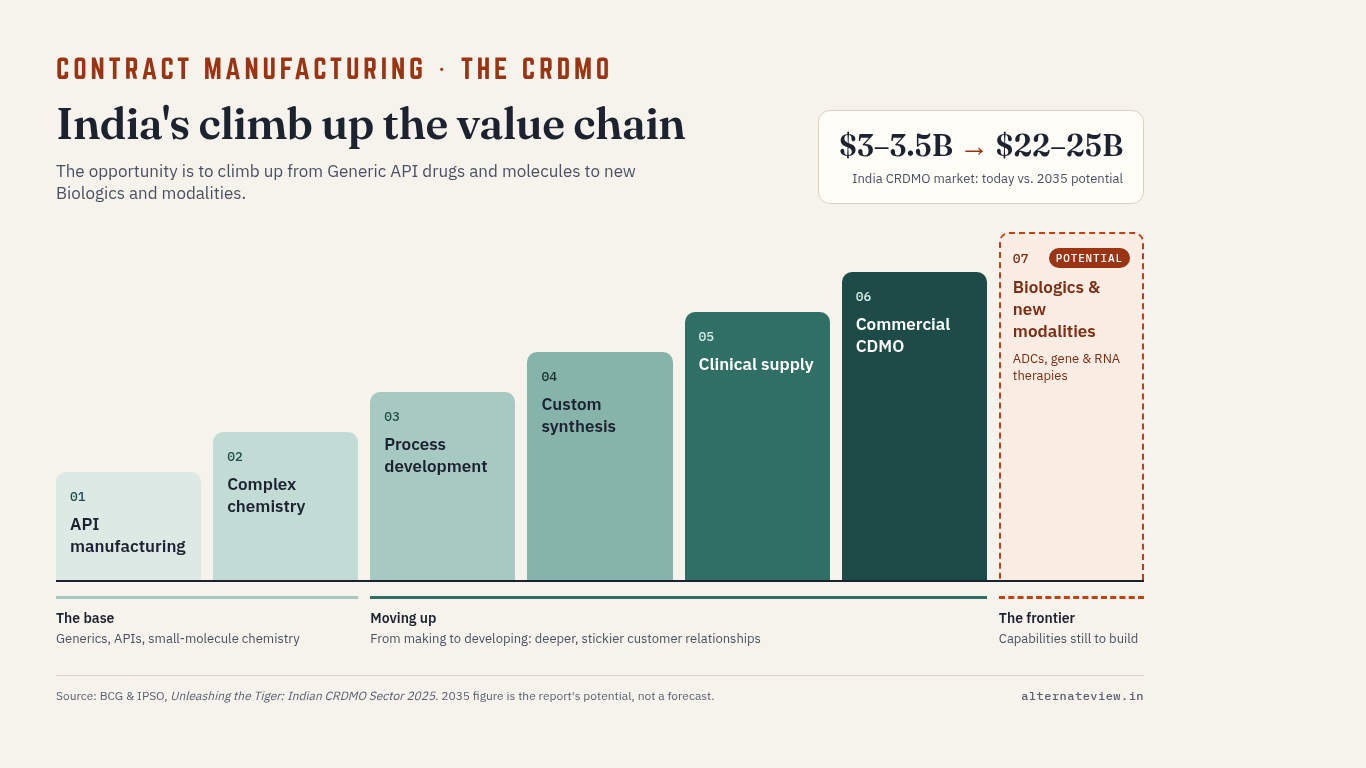
BCG’s 2025 report – Unleashing the Tiger: Indian CRDMO Sector 2025, estimated India’s CRDMO industry at approximately $3–3.5 billion as of 2025, representing 2-3% of global market of roughly $140-145 billion USD – but is expected to expand to $22-$25 billion USD by 2035.
The report identified India’s existing small-molecule capabilities as a foundation, while pointing to biologics, ADCs (Antibody-Drug Conjugates), gene therapies and RNA therapeutics as areas where the industry could build additional capabilities.
Because the industry co-authored it, its projections are best read as an ambition rather than a forecast. Its numbers are still useful:
That last point matters most. It is also where the real difficulty lies. Because not all pharmaceutical manufacturing is the same.
A conventional small-molecule API and a complex biologic may both ultimately become medicines, but the science, manufacturing processes, equipment, quality requirements and capital requirements can be radically different.
And that is why, before we look at the companies competing in this industry, we need to understand the molecules themselves.
6. The next question: What exactly are we manufacturing?
The pharmaceutical industry broadly spans two very different worlds.
On one side are small-molecule drugs, which are produced primarily through chemical synthesis.
On the other are large molecules and biologics, which rely on biological systems and substantially different manufacturing processes.
Within these categories sit newer and increasingly sophisticated modalities:
- Peptides
- Monoclonal antibodies
- Antibody-drug conjugates
- Gene therapies
- Cell therapies
- RNA-based therapies
Each requires a different combination of scientific expertise, manufacturing infrastructure and process development.
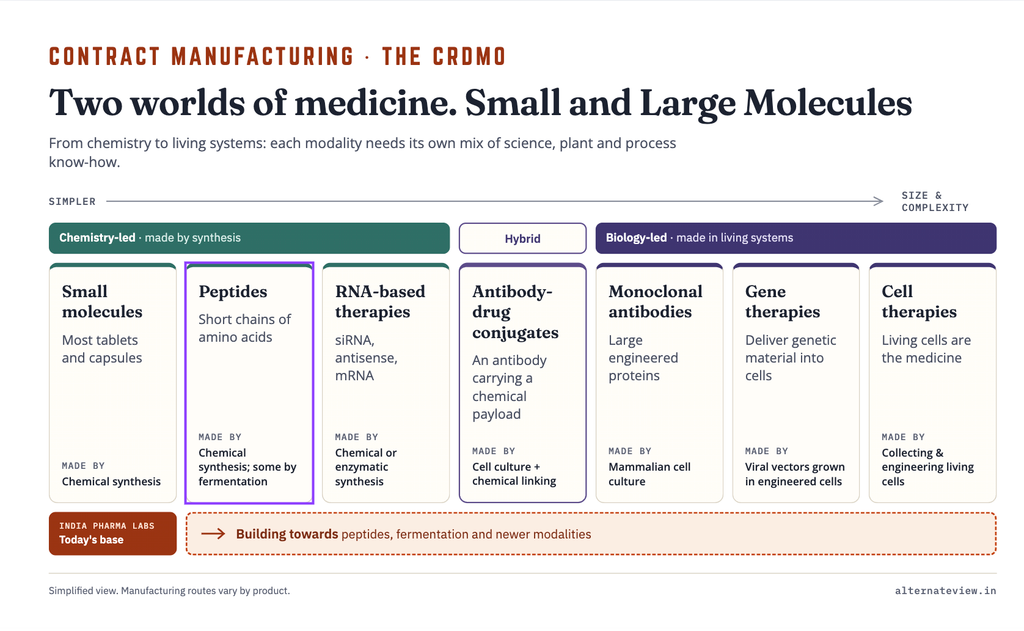
This distinction will become critical when we examine some Indian entities like Laurus Labs, Divis Labs etc. .
Because Laurus is not simply adding more API capacity. It is attempting to build capabilities across a much wider part of the pharmaceutical manufacturing spectrum from its traditional small-molecule base towards peptides, fermentation and newer modalities.
To understand what that transition actually means, we therefore need to step inside the molecule.
Small molecule first. Large molecule next.
Leave a Reply